Qualified Lead Growth Plan | PPC + CRO for Facilities Management
Overview
For GCC Facilities Management, I built a PPC-led lead generation plan designed to capture high-intent commercial cleaning enquiries and convert them through a conversion-focused landing page + qualified lead form.
This wasn’t a “spend more” idea, it was a funnel design: the right searches, the right message, the right page, and tracking that makes lead quality visible.
Note: This is a strategy proposal published as a portfolio version. Sensitive details and internal context have been removed.
My Goal
Create a scalable PPC framework that:
Targets commercial intent (not jobs / residential / low-quality queries)
Improves lead quality using better form design + qualification fields
Makes performance measurable through conversion tracking + CRM-ready lead capture
The Challenge
Facilities/contract cleaning is a crowded category. The main problems aren’t only clicks, they’re:
Competing against dozens of similar ads and generic claims
Trust barriers (decision-makers want proof, speed, and reliability)
Lead quality issues (forms that capture volume but not intent)
Weak visibility across the journey (ad → page → form → follow-up)
The Strategy
1) High-intent PPC structure (built for control)
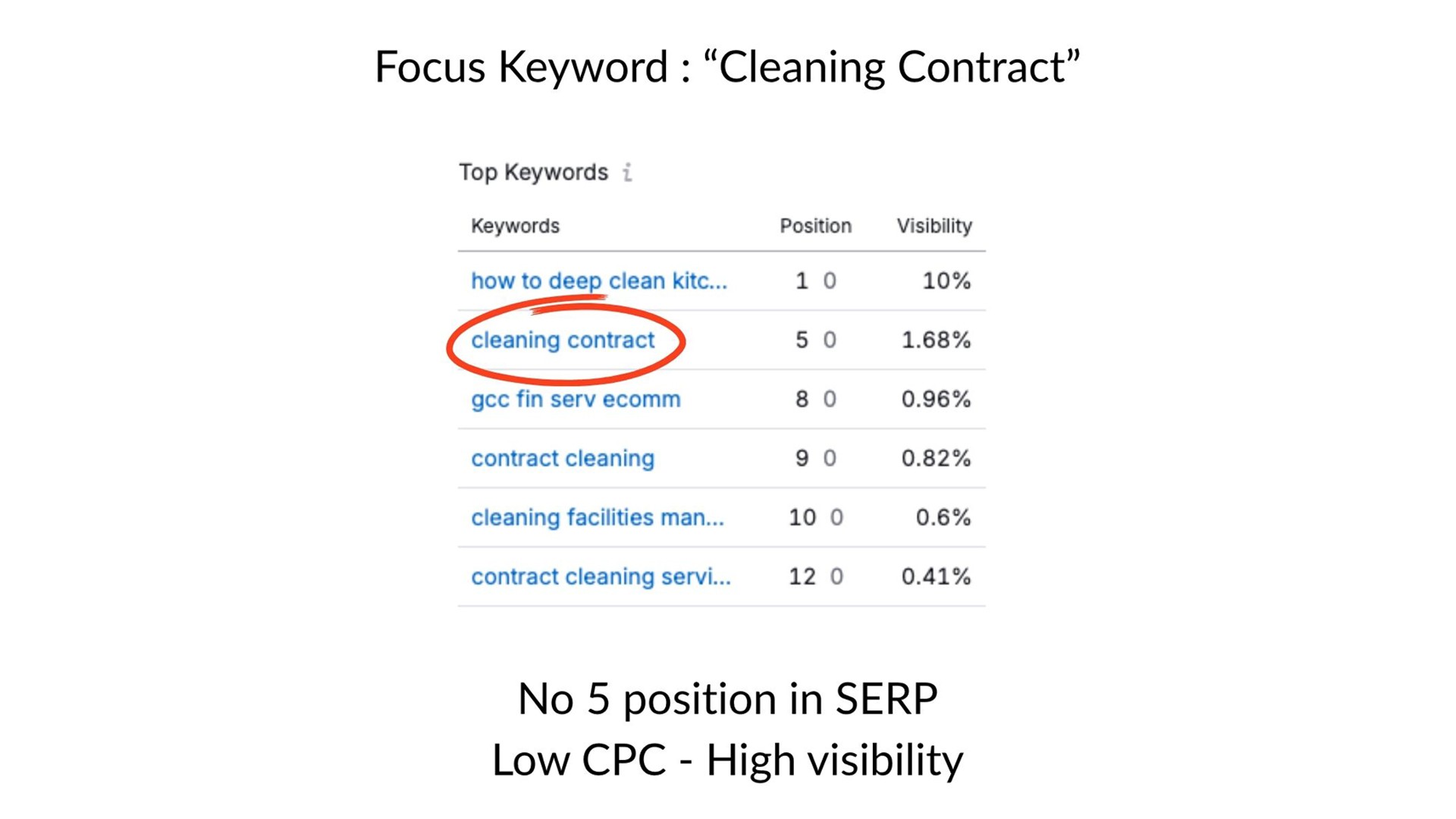
I mapped campaigns around services and intent, not broad “cleaning” terms.
Service-led ad groups (e.g., Office Cleaning / Contract Cleaning / Commercial Cleaning)
Exact + Phrase keywords for high-intent control
Negative keyword layer to remove noise (jobs, salary, domestic, residential, DIY)
Geo focus on priority areas (London / service radius)
Extensions to lift CTR + trust (call, sitelinks, location, structured snippets)
2) Messaging that sells trust, not hype
Instead of generic “best cleaning in London” claims, messaging was built around:
Response-time promise (speed-to-quote)
Reliability signals (experience, compliance, process)
Clear service scope (commercial / contract)
Direct CTA: quote request / site visit / call
3) CRO: a form that qualifies, not just collects
I proposed an A/B test between:
Short form (lower friction)
Qualified form (higher intent)
Qualified lead definition (used in the plan):
Business details + postcode + service need + start date + budget band
This approach helps sales teams spend time on the right leads first.
4) Tracking + CRM handoff (so quality is measurable)
The plan included a clean measurement setup:
Conversion events: form submit, call click, thank-you page view
UTMs + gclid capture for attribution
CRM fields: service type, postcode, start date, budget band, lead source
Speed-to-lead SLA recommendation for high-intent requests
My Role
In this project, I acted as the strategist and funnel designer:
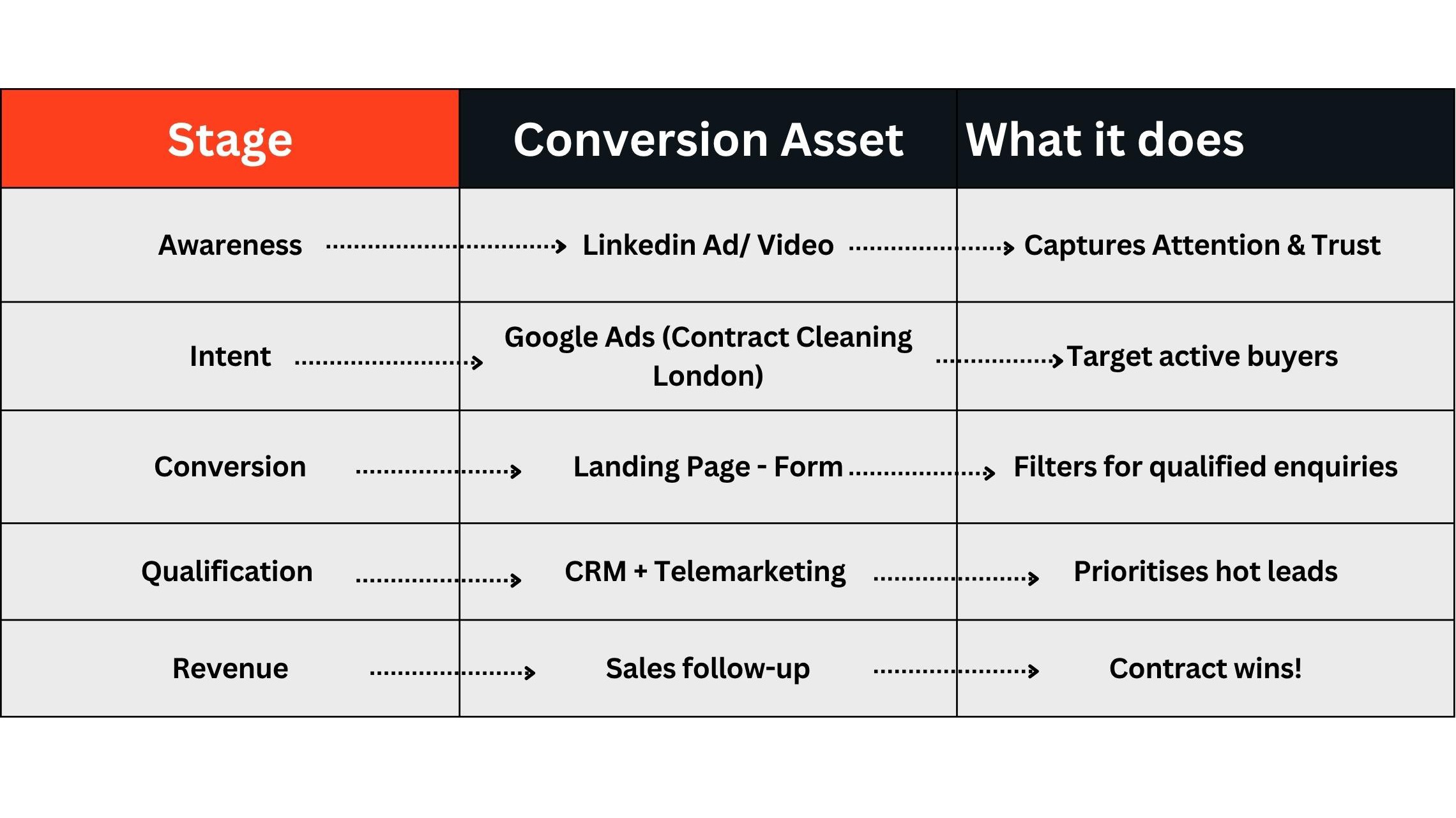
Mapped the customer journey and conversion points
Created Image Ads, Video Ads and Landing Pages
Designed a PPC structure with intent-led segmentation
Wrote/outlined ad messaging angles across channelsw
Planned landing page improvements and A/B test logic
Defined lead qualification fields and success metrics
Set tracking requirements for GA4/Ads + CRM readiness
Success Metrics
Because this was a strategy proposal, success was defined through measurable KPIs (not vanity metrics):
Primary
Cost per lead (CPL)
Qualified lead rate
Quote requests / booked site visits
Speed-to-lead performance
Secondary
CTR and impression share on high-intent terms
Landing page conversion rate (CVR)
Drop-off rate from landing page → form
Tools Used
Google Ads (campaign + ad structure planning)
SEMrush
Google Keyword Planner
GA4 (conversion tracking logic)
Canva (LinkedIn Ad + Video Ad)
UTM framework + CRM field mapping
What I Learned
A PPC account can look “active” and still leak money if the funnel is weak.
The biggest wins usually come from:
Cutting noise with intent + negatives
Making trust tangible in messaging + landing pages
Defining “qualified” up front and tracking it end-to-end
If you’re running lead-gen in a competitive space, small funnel decisions compound fast - the difference between more leads and better leads is almost always in the structure, the form, and the follow-up.